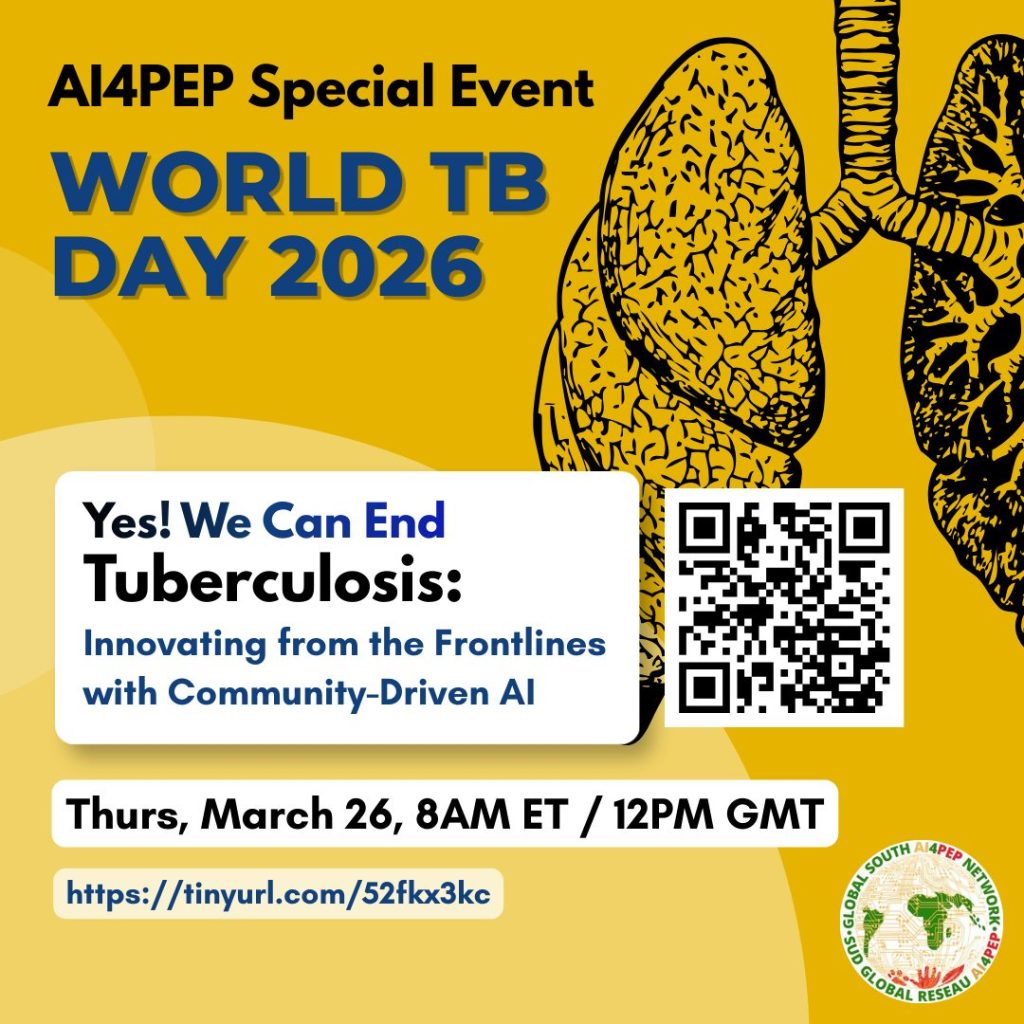
On March 26, 2026, the AI4PEP World TB Day event brought together health professionals, researchers, policymakers, and community advocates from across the Global South to tackle one of the most enduring public health challenges of our time: tuberculosis (TB). Broadcast live and now available in full online, the event offered a compelling blend of scientific insight, frontline experience, and forward‑looking innovation all centered on a shared conviction: Yes! We can end tuberculosis. Unlike many health forums that re‑run familiar talking points, this conversation cut to what matters most: actionable, equitable solutions shaped by those closest to the problem.
Tuberculosis remains one of the world’s deadliest infectious diseases, particularly in low‑ and middle‑income settings. Despite significant progress in diagnosis and treatment over recent decades, TB still kills more than a million people each year. In many regions of the Global South, the burden of TB intersects with poverty, weak health infrastructure, and social inequities, making effective response both a scientific and a systems challenge.
AI4PEP’s World TB Day event intentionally framed the day’s dialogue around community‑driven innovation, recognizing that the fight against TB must be grounded in local realities if it is to be effective and sustained.
Bringing Together Voices From the Frontlines
The event featured distinguished speakers whose work bridges clinical care, surveillance systems, and digital innovation:
- Dr. Jamal Eddine Bourkadi, Professor of Pulmonology and leader in national TB control efforts in Morocco
- Dr. Hasyirul Hashim, Clinical Lead for the Tuberculosis Watch (TBW) System in Malaysia
Both shared reflections on how TB continues to challenge health systems, especially in contexts where resources are limited and data systems are fragmented.
Dr. Bourkadi highlighted the ongoing need for robust case detection and community engagement. Drawing on his extensive clinical experience, he emphasized that innovations must build on strong health system foundations, including trained personnel, decentralized care, and trust between communities and providers.
Dr. Hashim then offered insights into how digital tools, including systems like the Tuberculosis Watch (TBW) platform, can enhance real‑time surveillance and care coordination. His experience underscores the value of combining technological innovation with strong governance frameworks that prioritize privacy, equity, and local ownership.
The Power of Community‑Driven AI
A central theme throughout the event was the role of community‑driven AI, not as a futuristic concept, but as a practical set of tools and processes that extend the reach and responsiveness of public health systems.
Several key points emerged:
1. AI as a Complement, Not a Substitute
Participants emphasized that AI should not replace human expertise but augment it. AI tools can identify patterns and risks faster than manual systems, but their value depends on human interpretation, adaptation, and trust. In TB response, this means models that support health workers, not systems that operate independently of clinical judgment or community context.
2. Connected, Not Centralized, Data Systems
A recurring challenge in TB control is the fragmentation of data, case reports, laboratory results, treatment adherence data, and community observations often live in separate silos. AI4PEP’s discussion highlighted the potential of AI to connect these streams, enabling earlier detection of trends and more coordinated responses. A holistic data approach strengthens decision‑making at local, regional, and national levels.
3. Prioritizing the Vulnerable
AI models run the risk of reflecting existing inequities if they rely solely on datasets that under‑represent marginalized populations. Speakers noted that ethical AI for TB must be built on inclusive data and validation strategies that ensure models work for the people most at risk, including those in rural areas and informal settlements.
4. Governance and Local Ownership
Technology governance came up repeatedly as a critical enabler. AI can accelerate insights, but without clear frameworks for accountability, transparency, and data sovereignty, the benefits may not be equitably distributed. Discussions stressed that countries should set their own priorities and guardrails, rather than adapting models designed elsewhere.
Shifting from Reactive to Proactive Systems
The term “epidemic intelligence” featured prominently in the dialogue. Participants explored how AI‑driven systems can move responses from reactive (responding after cases surge) to proactive (anticipating conditions that increase risk).
This includes:
- Early warning systems that synthesize climatic, demographic, and behavioral data
- Predictive analytics that highlight areas of emerging risk before outbreaks escalate
- Decision support tools that help allocate resources where they are most needed
For TB, this could mean identifying hotspots of transmission earlier, flagging disruptions in treatment adherence, or supporting outreach programs in hard‑to‑reach communities.
Real Stories, Real Impact
One of the most compelling aspects of the event was the grounding of abstract models in lived experience. Panelists shared anecdotes of communities where TB persists because social determinants, such as housing conditions, stigma, and access barriers, undermine treatment success. These stories brought a human face to the statistics and reinforced the need for solutions that are as much social and structural as they are technological.
What Comes Next
As the event closed, a clear sense of momentum emerged. Participants and attendees left with three shared priorities:
- Local Capacity Building: Strengthening the skills and infrastructure needed to deploy, interpret, and govern AI tools at the national and community levels.
- Collaborative Networks: Fostering cross‑regional dialogue and shared learning so that innovations in one context can inform practice elsewhere.
- Equitable Implementation: Ensuring that the design and deployment of AI technologies uphold principles of fairness, transparency, and community benefit.
In short, the future of TB response lies in innovation that is rooted in equity, shaped by local expertise, and guided by a commitment to shared well‑being.
Concluding Reflections
The AI4PEP World TB Day 2026 event was more than a commemoration. It was a call to action — a vivid reminder that ending tuberculosis is possible, but only if we align technology with human insight, and innovation with justice.
The discussions underscored that progress will not be measured solely by algorithms or dashboards, but by whether communities across the world feel safer, healthier, and more empowered.
This event was a step toward that future and, as the title declared, a confident affirmation: Yes! We can end tuberculosis.
Watch Here: