A Public Guide to Understanding AI Today and Shaping its Future
Artificial intelligence (AI) is no longer a distant concept. It is embedded in how we communicate, learn, work, and make decisions. From healthcare systems and financial services to education and agriculture, AI is reshaping societies at an unprecedented pace.
Yet despite its growing influence, AI remains widely misunderstood. Conversations often focus on tools like ChatGPT or image generators, while overlooking the deeper systems, histories, and power structures that shape how AI works and who it benefits.
This blog offers a comprehensive, accessible guide to AI: where it comes from, how it works, where it is applied, and why governance and inclusion matter now more than ever.
From Ancient Ideas to Modern AI
The idea of artificial intelligence did not begin with computers. For centuries, humans have imagined machines capable of thought and action, from mythological automata to early mechanical devices.
The foundations of modern AI were laid through mathematics and philosophy. Thinkers like Alan Turing proposed that machines could simulate human reasoning, while early computer scientists demonstrated that logic and computation could be formalized.
The formal birth of AI as a discipline came in 1956 at the Dartmouth Conference. Since then, the field has gone through cycles of optimism and disappointment, often referred to as “AI winters”, before arriving at today’s era of rapid advancement.
What we are witnessing now is not a sudden breakthrough, but the result of decades if not centuries of intellectual development.
So What Truly Is AI?
AI refers to systems that can learn from data and perform tasks without being explicitly programmed step by step. Today’s AI is “narrow,” meaning it is designed for specific tasks—like diagnosing diseases, generating text, or detecting fraud.
There are three main types of AI shaping today’s world:
-
Discriminative AI: predicts and classifies
-
Generative AI: creates content
-
Agentic AI: plans and takes actions to complete tasks autonomously
AI is evolving quickly from tools that respond to prompts to systems that can act and make decisions.
So How does AI Work?
AI systems learn from data. The more data they are trained on, the better they can identify patterns and make predictions.
Most modern AI systems rely on neural networks, which are loosely inspired by the human brain. These systems process information through layers, gradually learning more complex patterns.
A major breakthrough came with the development of the transformer architecture, which powers today’s most advanced language models. This innovation allows AI systems to understand relationships between words, images, and other data at scale.
However, AI systems are only as good as the data they are trained on. If the data contains bias, gaps, or inaccuracies, the system will reflect and often amplify those issues.
AI is not a neutral technology. It can reinforce existing inequalities, raise serious privacy concerns, and contribute to the spread of disinformation through increasingly realistic synthetic content. At the same time, the development and control of AI systems are concentrated in a small number of companies and countries, raising broader questions about power and global equity. These challenges highlight the urgent need for effective governance.
Efforts to regulate AI are beginning to take shape, but they are still catching up with the pace of technological change. For AI to truly serve the public good, governance approaches must be inclusive, context-aware, and grounded in the realities of different regions, especially in the Global South, where the impacts of AI can be both transformative and uneven. Ensuring that diverse voices are included in shaping AI systems is essential to building technologies that are fair, accountable, and beneficial to all.
AI will continue to evolve and expand its influence in the years ahead. The key question is not whether it will shape our future, but how and for whom. Understanding AI is a critical first step, but meaningful engagement in how it is developed and governed is just as important.
Find out More
For readers interested in a deeper and more comprehensive exploration, you can access the full reference document here:
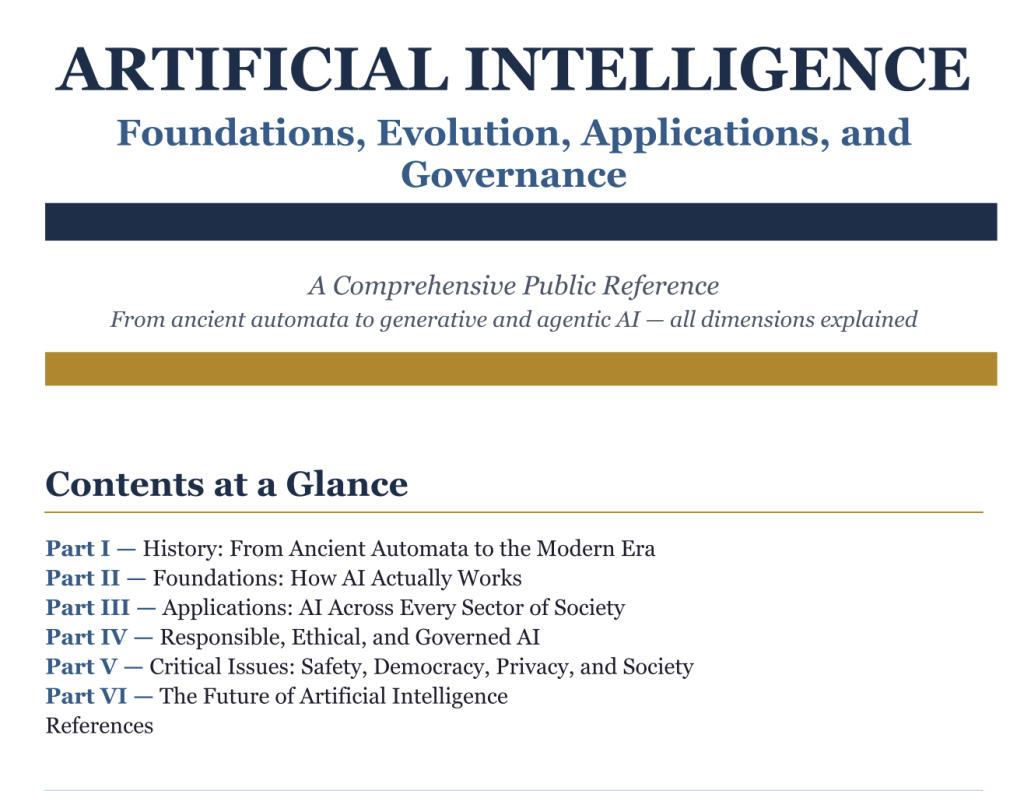
ARTIFICIAL INTELLIGENCE: Foundations, Evolution, Applications, and Governance
This extended guide covers the history, technical foundations, real-world applications, ethical considerations, and governance challenges of AI in much greater detail, and is intended as a resource for ongoing learning and informed engagement.